
What is the FrankenQuilt Method
Formerly Known as Quilt as You Piece
The FrankenQuilt Method is an alternative way of piecing quilt blocks within the Quilt‑As‑You‑Go family of techniques.
In short, when you finish piecing a block using the FrankenQuilt Method, it is already layered and either fully quilted or ready for quilting.
I’m not claiming this is a brand‑new invention, but I haven’t been able to find this exact block‑building method anywhere. If it already exists, I’d love to know so I can add that resource here. My inspiration came from Candy Glendening’s technique for joining large quilt sections—layering them and quilting as she built the quilt. I simply took her idea one step further and applied it at the block level instead of the whole‑quilt level.
This method is especially wonderful for throw‑size quilts where both sides are visible. I’ve made both king‑ and queen‑size quilts using this technique, and I love having the option to choose which side faces up on my bed.
I prefer joining my blocks in a way that makes it difficult to tell whether the quilt was made using a Quilt‑As‑You‑Go method. I’ve used sashing to join blocks, but I design the sashing so it blends into the quilt—using the same fabrics as the background or outer edges of the blocks—so the join isn’t obvious to the untrained eye.
- Features of The FrankenQuilt Method
- Similar in spirit to Quilt‑As‑You‑Go.
- Creates a truly reversible, double‑sided block.
- The back of the block mirrors the pattern on the front.
- Front and back use different fabric prints.
- Batting pieces are cut to the same shapes as the block pieces, but slightly smaller.
- Each piece is quilted as it is layered onto the block.
- Edge‑to‑edge quilting is possible, eliminating the need to knot thread starts and stops.
- Quilting each piece as you add it can be done by hand if preferred.
- Additional decorative quilting can be added after the block is constructed, just like traditional Quilt‑As‑You‑Go.
- Scrap batting works well as long as all pieces are the same type.
- Fusible flat cotton or 80/20 cotton/poly batting works best.
- Most traditional quilt blocks can be adapted to this method.
- Most foundation‑pieced blocks can be converted to this method.
- Many paper‑pieced blocks can be made without paper using this method (very intricate blocks with tiny points may be challenging).
- If all blocks share the same layout, you can chain‑piece them.
- Excellent for scrap‑busting: use scraps for the back of your blocks while using your chosen fabrics for the front.
- Perfect for quilts where both sides will be seen—such as lap quilts—because you can coordinate fabrics for a cohesive look on both sides.
In this section of the site, I’ll focus mainly on constructing blocks using the FrankenQuilt Method. I do plan to offer full quilt patterns, but those will be available for members (via points) or for purchase. Non‑members will still be able to see sample layouts made from the blocks.
I have plenty of scraps that are perfect for sampler quilts, and your quilt can look completely unique depending on what you use. I don’t list fabric names because I simply use what I have or what I can find affordably. Some materials may even be unconventional! For example, you can make a throw quilt from a roll of 2.25" jelly‑roll rug batting. I’ve also used the little 2" × 8" polyester batting inserts from jewelry gift boxes—leftovers from packaging my paper bead rollers. I had about 1,000 of them and used them in a king‑size quilt. You *can* buy these inserts, but 1,000 pieces would cost around $300, so I recommend sticking with regular batting and cutting your own pieces.
This section isn’t intended for absolute beginners. There are many excellent YouTube videos that teach basic quilting and Quilt‑As‑You‑Go techniques. I’ll be adding links to various joining methods so you can choose the one that works best for your projects.
Here’s a helpful tip for estimating how much scrap fabric you’ll need for the back of your blocks: Weigh the fabric you purchased for the quilt top before cutting it. Then pull out your scraps and match that weight. Make sure your scraps are at least larger than the smallest piece in your quilt top. Since you’ll naturally have scraps left over from cutting your top, matching the weight usually ensures you have enough for the back. Or, of course, you can simply buy the same amount of fabric for the back side.
A Childhood Moment That Sparked the FrankenQuilt Method
I’ve been sewing since I was seven years old — back in 1973 — making tiny Barbie clothes by hand and discovering early on that crafting was simply part of who I was. Around that same age, I saw my very first handmade quilt in a friend’s or relative’s home, don't remember where, I just remember the quilt. I remember admiring the front, turning it over with curiosity, and feeling genuinely surprised that the back was plain. In my mind, I expected the back to like the front — the same pattern, just in different colors. That small moment stuck with me. Even then, I wanted quilts to be beautiful, and interesting on both sides. Decades later, that childhood instinct grew into the foundation of the FrankenQuilt Method: a way of building quilt blocks so the back is every bit as thoughtfully designed as the front. Yes, I’ve made quilts the traditional way, but this method simply works better for me. I don’t need a longarm, and I don’t have to fight the weight and bulk of a whole quilt stuffed into the harp of my sewing machine. The only thing under the harp is the piece I’m stitching — not an entire quilt.
How the FrankenQuilt Method Became My Way of Quilting
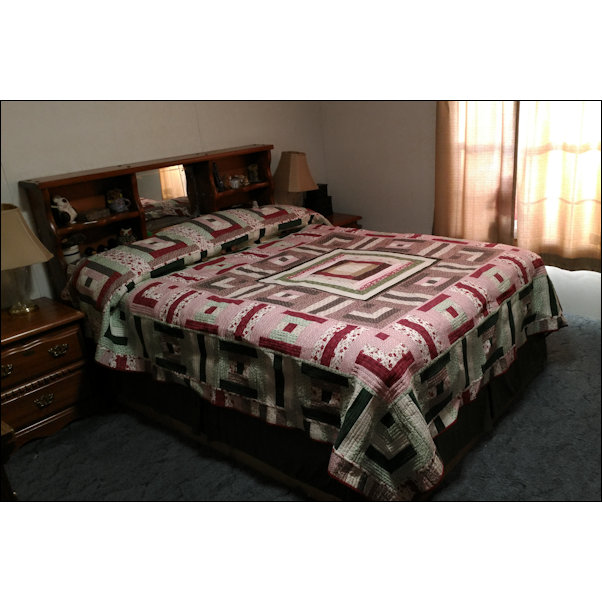
I made my first FrankenQuilt‑style quilt long before I ever named the method. In early 2017, I pulled out a quilt top I had started when I was about 14 years old — a large single‑block Courthouse Steps design. When I looked at it with adult eyes, I realized how unattractive it really was. So I took it apart, salvaged the usable pieces, and used them in the quilt shown here. The center Courthouse Steps block is made from that original fabric, and I integrated the rest into several other blocks. That was the moment I decided to try building my new quilt using the technique that had been simmering in my mind.
A few weeks after starting that quilt, my stepson Kevin announced he was getting married again, so I made a quilt for Kevin and his bride using this same technique — all while continuing to work on the quilt that now sits on our guest bed.
Then in 2019, I made a traditional baby quilt for Matthew, who was born on October 15, 2019. By the time I finished the guest‑room quilt in April 2020, I realized something important: I had been working on three quilts at the same time — two using the FrankenQuilt Method and one traditional — and the traditional one was the hardest of the three. Even quilting a small baby quilt on my domestic machine was more work than building my FrankenQuilt Method quilts.
That experience confirmed for me that this method wasn’t just easier — it was the way I wanted to quilt from then on.
All items in our online shop ship free within the US only. I currently offer U.S. shipping only and it is from rural Maine. Delivery can vary from 2–14 days depending on your distance from Maine. Expedited shipping is not available.
Please note: I am now selling all of my paper bead making tools and other items from this web site using Paypal payments.
I have removed all of my paper bead making tools from Amazon. My Kindle crochet pattern books and paper template paperback books continue to be available on Amazon, as they are printed and fulfilled directly by Amazon. If you would like to shop my Etsy Store, follow the link in the header above.
Random Quick Tip!
Save Ink While Printing Bead SheetsWhen setting up your printer for printing bead sheets, be sure to set your DPI to no more than 150 dots per inch. You don't need the extra ink that a higher resolution produces and by reducing the resolution, you lessen the chance of ink bleed when you dip or glaze your paper beads.