
Easter Egg
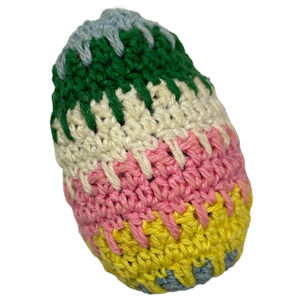 Designed by Julie A. Bolduc
This striped little crocheted easter egg is really easy to make and uses a variation on the static stitch.
Materials Needed:
Small amount each size 10 crochet cotton Southmaid
Country Blue, Pink, White, Yellow, Green
Yarn scraps or polyester fiberfill for stuffing.
Size 7 steel crochet hook
Yarn Thickness: 10thread
Stitch Gauge: 10sc=1"
Finished Size=1.5"x2.5"
Skill Level: Beginner
Instructions
With blue
RND 1: Ch 2, work 12 sc in 2nd ch from hook. Join with sl st in first sc.
RND 2: Ch 2, hdc in same st as slst. Work 2 hdc in each sc around. Join w/slst in top of ch2.
RND 3: Ch5, *sk 1 hdc, dc in next dc. ch2. Rep from * around. Join with sl st in 3rd ch of ch 5. Fasten off blue.
RND 4: Tie on yellow thread in one of the dc. Sc in same dc. *2Dc in row 2 working over the ch2 sp of rnd 3, in the sk sc. Sc in next dc. Rep from * around. Join with sl st to first sc.
RND 5: Ch2, work 1 hdc in each st around. Join with sl st to top of ch2.
RND 6: Ch 4, *sk 1 st, dc in next st, ch1. Rep from * around. Join w/slst to 3rd ch of ch 4. Fasten off yellow.
RND 7: Tie on Pink thread in one of the dc. Sc in same st. *1 dc in RND 5 working over the ch1 sp of RND 6 in the sk st. Sc in next dc. Repeat from * around. Join with slst in first sc.
RND 8: Ch 2, work 1 hdc in each st around. Join w/stst to top of ch 2.
RND 9: Ch 4, *sk 1 st, dc in next st, ch1. Rep from * around. Join w/slst to 3rd ch of ch 4. Fasten off pink.
RND 10: Tie on white thread in one of the dc. Sc in same st. * dc in RND 8 working over the ch1 sp of RND 9 in the sk st. Sc in next dc. Rep from* around. Join with slst in first sc.
RND 11: Rep RND 8.
RND 12: Rep RND 9. Fasten off white
The next few rnds is where you will be decreasing stitches.
RND 13: Tie on green thread in one of the dc. Sc in same st. * dc in RND 11 working over the ch1 sp of RND 12 in the sk st. Sc in next dc. Rep from* around. Join with slst in first sc.
RND 14: Ch 2, * 'hdcDec' over the next two sts. * Hdc in next st. Rep from * around. Join w/slst in top of ch2.
RND 15: Rep RND 9, fasten off green.
RND 16: Tie on Blue thread in one of the dc. Sc in same st. * dc in RND 14 working over the ch1 sp of RND 15 in the sk st. Sc in next dc. Rep from* around. Join with slst in first sc.
RND 17: Rep RND 14.
RND 18: Ch 1, *dec over the next two sts, sc in next st. Rep from * around. Join w/slst in first ch in rnd. Cut thread and leaving long & run thread through the stitches to gather up to close. Secure and fasten off. Weave ends into work.
How to decrease in hdc. Special Abbreviation (hdcdec)
Yo insert hook in next st pull up a loop, insert hook again in next st and pull up another loop then yo and draw thread through all 4 lps on hook.
How to decrease in sc.Insert hook in st, pull up a loop, insert hook in next st and pull up another loop then yo and draw thread through all three lps on hook.
Design written in April 1998 Copyright © 1998 Julie A. Bolduc f116002
All items in our online shop ship free within the US only. I currently offer U.S. shipping only and it is from rural Maine. Delivery can vary from 2–14 days depending on your distance from Maine. Expedited shipping is not available.
Please note: I am now selling all of my paper bead making tools and other items from this web site using Paypal payments.
I have removed all of my paper bead making tools from Amazon. My Kindle crochet pattern books and paper template paperback books continue to be available on Amazon, as they are printed and fulfilled directly by Amazon. If you would like to shop my Etsy Store, follow the link in the header above.
Random Quick Tip!
Keep Kids Safe At HalloweenGet some reflective tape and put pieces of it on the back side of your child's costume. That way, at night, cars and people can see them. Or make the tape as part of the costume and cut out fun shapes and put them all over the costume.